01 — The client and the context
Ladders, guardrails and walkways where there's no room for error
Creda Enterprise designs and builds industrial aluminum ladders — platform, crossover and caged — fall-protection guardrails and service walkways, modular or custom-made. From its operating office in Corsico, just outside Milan, it works for the aviation, food, rail and energy industries.
Almost nothing comes out of a catalog: every job starts from a drawing, and the drawing comes with its 3D model attached. That's why their Odoo is no lightweight system — it's over ten gigabytes of database and document archive, with thousands of CAD files attached to job orders.
Some of the companies they have worked for






02 — The challenge
A version to leave behind, and a new partner starting from scratch
Odoo 16 has reached end of support: it no longer receives security fixes or compliance updates when tax rules change. At QTNOVA we no longer install version 16, and we don't leave clients on a version we can't defend. That much is a technical choice, agreed with the client before we started.
The hard part was something else. Creda came from another Odoo partner, and we didn't know their workflows: we didn't know how each department worked, which customizations were essential and which had stayed out of habit, where the system followed the way the company worked and where the company had bent to fit the system instead. None of this is written in the code, and the people who wrote it were no longer around.
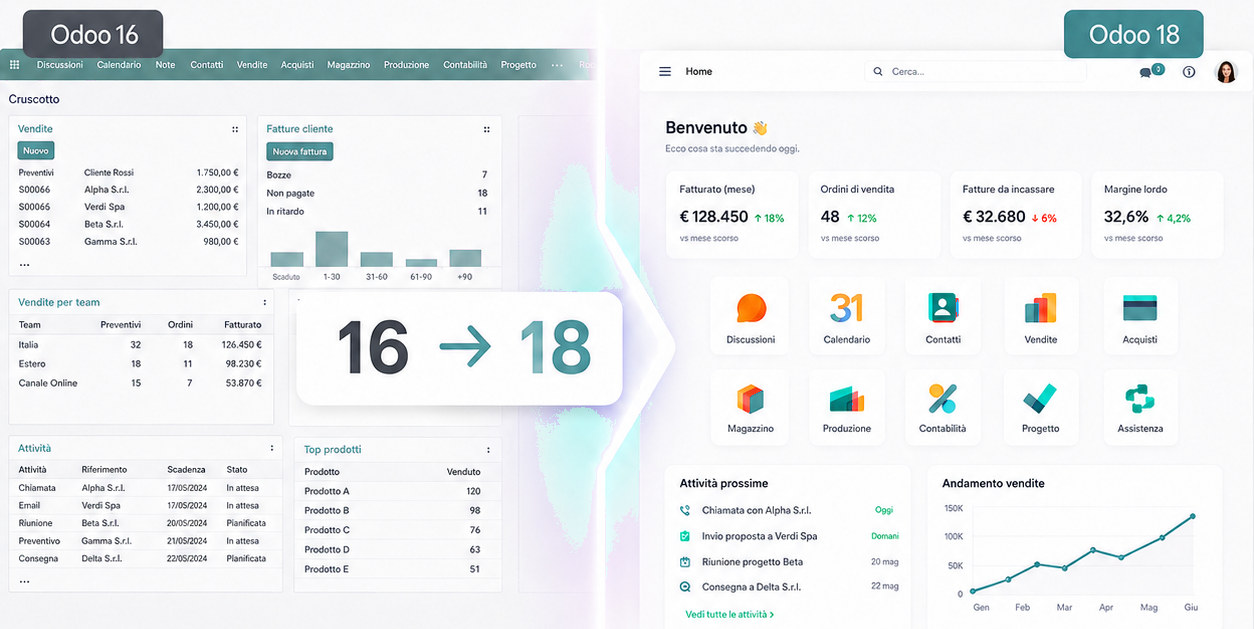
Migrating without that knowledge is the fastest way to break something without noticing: a moved field or a simplified view can be harmless or can bring a department to a halt, and you can't tell the difference from a log. On top of all that, the technical jump wasn't a single one: going from 16 to 18 means passing through 17, with two full migrations back to back across more than two hundred thirty modules, custom software written for 16, and the Italian tax stack to rebuild from scratch.
“A version out of support no longer receives security fixes or compliance updates when tax rules change. We don't leave clients where we can't protect them.”
03 — The solution
One move, two goals
The environment wasn't migrated in place: it was moved from the previous partner's servers to ours and, in the same move, upgraded by two versions. Doing them separately would have meant two rounds of downtime and two rounds of acceptance testing; doing them together means following the rules of the trade to the letter, because there's no room left to improvise.
Infrastructure move
From their servers to ours
- Full restore of the database and document archive.
- Integrity verified before touching any version.
- Source environment left untouched until testing was complete.
Two versions in one move
16 → 17 → 18
- One version jump at a time, never two at once on the data.
- Always migrated on a copy, never on the live environment.
- Every fix repeatable, so everything can be rerun from scratch.
The custom software
Carried forward, not shelved
- Every method ported to the version 18 interfaces.
- File-by-file comparison between version 16 and the new one.
- Obsolete code removed, not dragged along.
The Italian tax stack
Replaced with Odoo's native stack
- E-invoicing and the SdI channel (Italy's e-invoicing exchange system) moved to Odoo.
- History of invoices already issued transferred to the new setup.
- RiBa bank receipts and declarations of intent moved over and recounted.
There was only one truly delicate point: the e-invoices already issued had to find a new home. They were stored in version 16's custom modules and moved to version 18's native ones, each keeping its own status with the SdI. Not an upgrade: a transplant, carried out without a single document losing its history.
04 — The workflow
Understand the business first, then touch the system
The order of the steps is what makes the difference. You don't cancel risk with a promise: you move it to an environment where mistakes cost nothing, and you pay for it there.
-
Business workflow analysis
Before touching anything, understand how the company works: who does what in each department, which customizations are essential and which have stayed out of habit, where the system follows the way people work and where it's the other way around.
-
Test environment on our servers
A full copy of production — ten gigabytes of database and attachments — restored on our infrastructure and migrated to 18. Nobody at the company notices: work carries on in 16.
-
Repeated trials until a clean run
We run the migration end to end, see where it stops, fix it and start again from the untouched copy. Every fix is a rerunnable script, never a manual change: that's the only thing that makes the final trial identical to the real switchover.
-
Testing with the people who use it
Staff from each department try the new version in the test environment, with the company's real data, and compare it with the one they use every day. The differences that matter surface here, not in the logs: a moved column, a filter that's gone, a changed printout.
-
Agreed date and switchover
Only when testing is signed off do we set the switchover date, and it runs with the same scripts in the same order we already tested. No surprises, because there's nothing new left to discover.
One rule applies to all five steps: nothing gets deleted. Modules that no longer exist in 18 were switched off, not removed, and their tables stay where they are. It costs a few database rows, and it's worth it to be able to answer when, a year from now, someone asks what happened to a document from 2019.
The trials surfaced twenty-eight issues, each documented with its cause and closed with its fix, for a total of seventeen scripts, some to run before the migration and some after. None of those twenty-eight reached production: the risk was spent in testing, while at the company it was a week like any other.
05 — The result
No department stopped
The switchover took place at the end of June 2026, and the company didn't have to stop. Sales, production, warehouse and administration kept running: no days to make up, no orders left waiting for the system to come back.
The credit doesn't go to a promise kept at the last minute: it goes to the testing done beforehand with the people who use the system. When 18 went into production, staff had already seen it on their own data and knew what to expect.
In the days that followed, we stayed by their side, on site at the company: with a new interface, some questions only come up when you use it for real work, with a customer waiting on the phone. Small visual tweaks, views to put back where people looked for them, habits to rebuild. All sorted out with the system running, without ever stopping anyone from working.
- All departments running
- No department down during or after the switchover. Adjustments were made with the system running, not by closing up shop.
- History intact
- Orders, job orders, stock moves, e-invoices and bank receipts moved to the new version and were recounted one by one once the migration was complete.
- Customizations kept alive
- The custom software wasn't shelved to make the jump easier: it was ported to 18 and, in the months since, has already gone through four new feature releases.
- Regulatory updates included
- With e-invoicing on Odoo's native modules, when a rule changes, the update ships with the version, not as a separately quoted job.
06 — The value
An upgrade isn't a project, it's maintenance
This migration took about ten days because Creda came from another partner, and there was a setup to get to know before touching it. For the clients we look after, later version upgrades are already included in the AMS (Application Management Services) fee.
- No surprises on support Staying on a supported version isn't a decision to revisit every two years: it's the normal state we keep our clients in.
- Customizations come along Custom code moves forward with the version instead of being abandoned at the first jump. That's why a migration doesn't force you to start over.
- Regulatory updates included With the native tax stack, when a rule changes, the update comes from Odoo, not as a separately quoted job.
- The risk stays on the copy Trials run on a separate environment as many times as needed. Production only sees the version that has already worked.